AI Discoverability  ·  Schema Architecture

Schema issuance.
Directory authority.
Reference infrastructure.

Schema vocabulary
916 types  ·  1,453 properties
Confirmed edges
Baked in. Permanent. Compounding.
Primary channel
SEO agencies  ·  White-label
916 schema types issued
1,453 properties covered
46,600 pages indexed — 60 days
SEO Agencies · Enterprise · Local Business
Provenance declared. Edges permanent.
The Architecture

Three deliverables.
One infrastructure layer.

Every engagement runs on the same pipeline. Schema measured, edges declared, provenance baked in. The output is permanent — a compounding asset in the graph that grows in authority as the registry expands.

Service 01
Schema Issuance
Flagship

Every domain measured against the complete schema.org vocabulary — 916 types, 1,453 properties. Every applicable type identified. Every gap documented. The complete JSON-LD block issued for deployment on your own domain. Before and after schema scores recorded as a permanent operational finding.

Most implementations cover a handful of obvious types. This covers the complete vocabulary as it applies to your entity — every service, every location, every relationship, every edge declared at the machine layer. The difference between a schema score of 34 and 91 is not complexity. It is completeness.

  • Full vocabulary gap analysis against your domain and industry
  • Complete JSON-LD block issued — ready for deployment
  • Before and after schema score documented
  • Human-verified before issuance. Every property traceable.
  • Entity profile minted in the registry with confirmed edges
Before issuance
34
Average schema score
After issuance
91
Documented improvement
Service 02
Directory Architecture
Authority Infrastructure

A structured, machine-readable directory functions as an authority node in the graph. Every entity listed receives confirmed edges to every other entity in the directory. The directory itself becomes a citable source — one AI systems traverse, index, and reason from across the entire category it covers.

This is the architecture behind the documented result: a local bar appearing alongside WikiVoyage in Google AI summaries. The directory made the bar machine-readable as part of a connected graph, not an isolated listing. AI systems follow edges. Build the edges correctly and they find you — repeatedly, permanently, at scale.

  • Full schema architecture on every entity in the directory
  • Confirmed edges declared between all listed entities
  • Directory registered as an authority node in the graph
  • Machine-readable from day one — crawlable, citable, permanent
  • Compounding: every new entity strengthens the entire directory
Service 03
Reference Infrastructure
Substrate Layer

Reference documents — not blog posts. Structured, schema-backed, provenance-declared content that functions as the substrate AI systems reason from. Every claim traceable. Every entity relationship declared. Every document connected to the graph it belongs to.

The distinction between content and reference infrastructure is provenance. A blog post is written for humans. A reference document is written for machines — with human accessibility as a secondary output. AI systems index reference infrastructure differently. They cite it differently. They return to it differently.

  • Full schema markup on every reference document produced
  • Provenance declared at every claim — sources traceable
  • Entity edges baked in — connected to the registry graph
  • Indexing acceleration documented — 46,600 pages in 60 days
  • Permanent compounding asset — grows in authority over time
For SEO Agencies

Your infrastructure.
Your clients. Your margin.

The scale play is agencies. One agency relationship equals an immediate pipeline of clients. You bring your book of business. We deliver the schema architecture, the graph edges, the before-and-after documentation. White-labeled under your brand.

Every client you bring gets a schema score before and after. Measurable, documented, presentable. The kind of deliverable that converts retainers and renews contracts. Your clients become machine-readable. Their authority compounds in the graph. You own the relationship.

We wholesale the infrastructure. You set the margin.

Partner With Us →
1
Agency onboards
Single partnership agreement. Access to the full schema pipeline. White-label delivery framework established.
10–50
Clients per agency
One agency relationship generates an immediate client pipeline. Schema issuance runs on each domain. Documentation delivered per client.
Compounds forever
Every client profile minted in the registry adds weight to every other client in the graph. The portfolio becomes an interconnected authority network.
The Machine Layer

What AI finds when it reads your domain.

AI systems reason across structured data. They follow entity relationships and build confidence through provenance. The difference between a domain that gets cited and a domain that gets passed over is structural — not content volume, not backlinks.

⚠  Unstructured domain
StructureFlat documents. No declared relationships.
Entity connectionsNone declared at the machine layer
ProvenanceAbsent — AI fills gaps independently
Schema coverageA handful of obvious types
AI behaviorRead once. Extracted. Moved past.
ResultInvisible in AI-generated answers
✦  GraphSignal architecture
StructureLiving graph — traversable, connected
Entity connectionsConfirmed edges to verified entities
ProvenanceDeclared at every layer of the domain
Schema coverageFull 916-type vocabulary
AI behaviorTraverses the domain. Cites repeatedly.
ResultThe source. Permanent. Compounding.
Operational Findings

Documented results.
Structure did the work.

Three measurements from live deployments. No ad spend. No link building. Graph architecture alone.
Finding 01
Finding 01
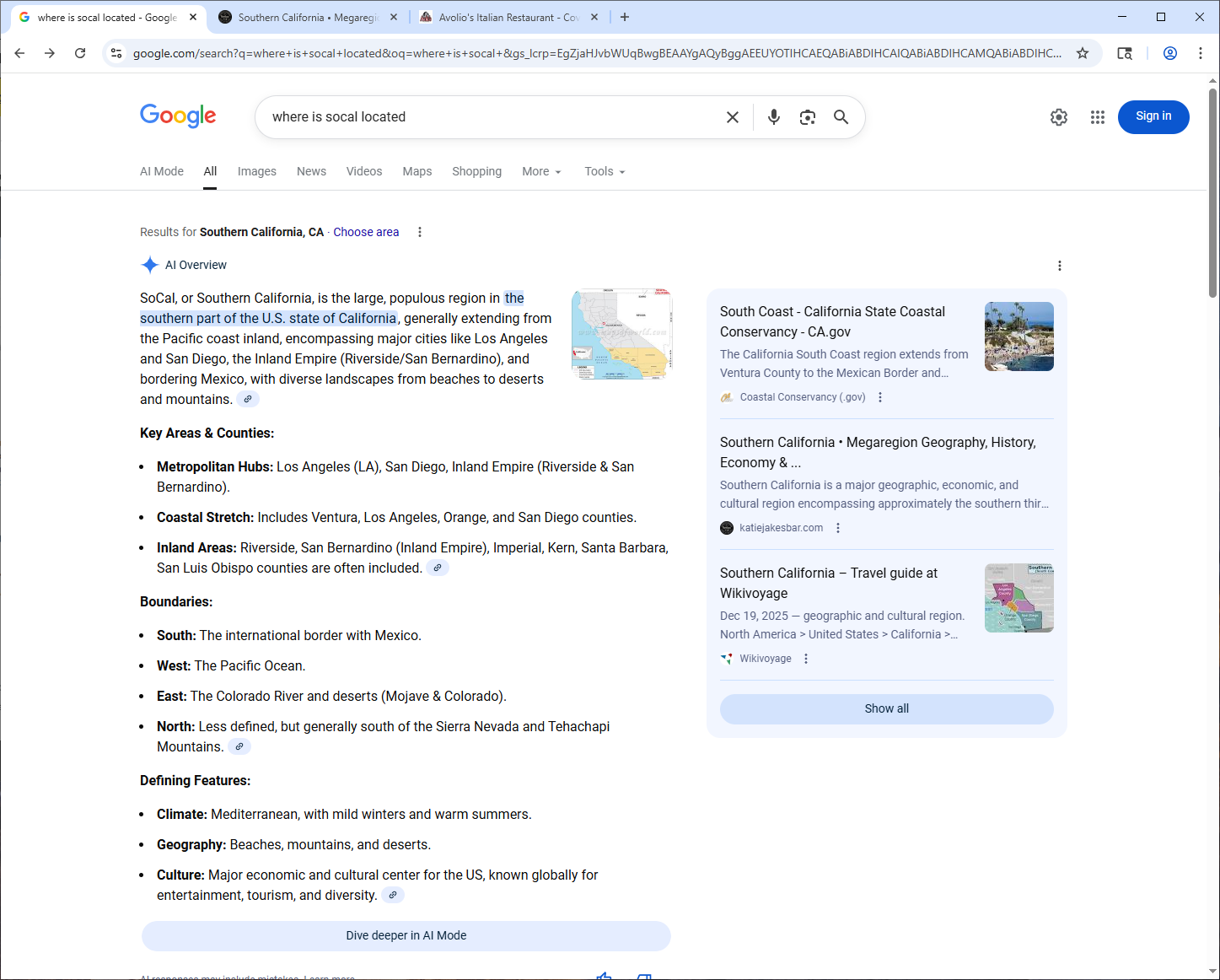
Local Bar — WikiVoyage — Google AI Overview
Finding 01
Local Bar Cited Alongside WikiVoyage
Finding 02
Finding 02
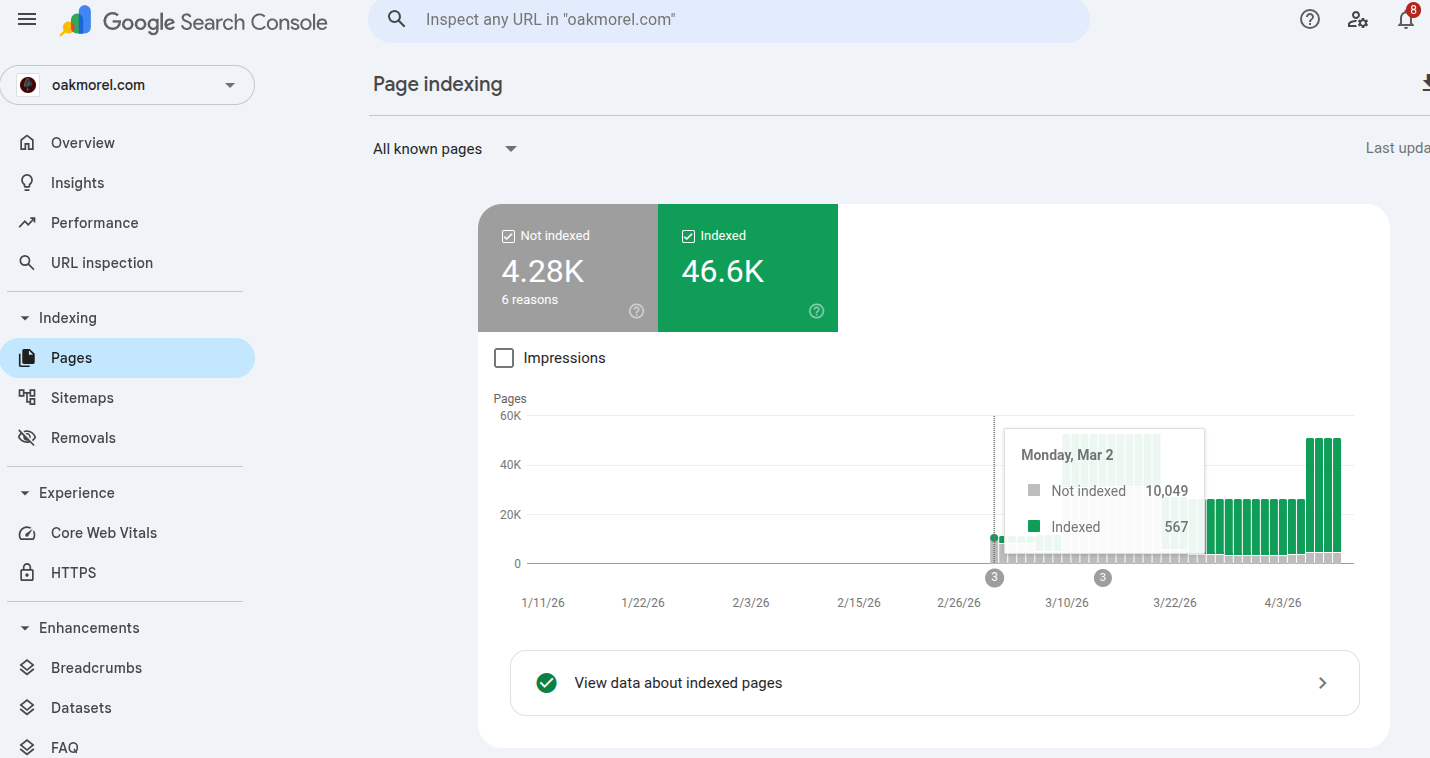
46,600 Pages Indexed — Google Search Console
Finding 02
46,600 Pages Indexed Under 60 Days
Finding 03
Finding 03
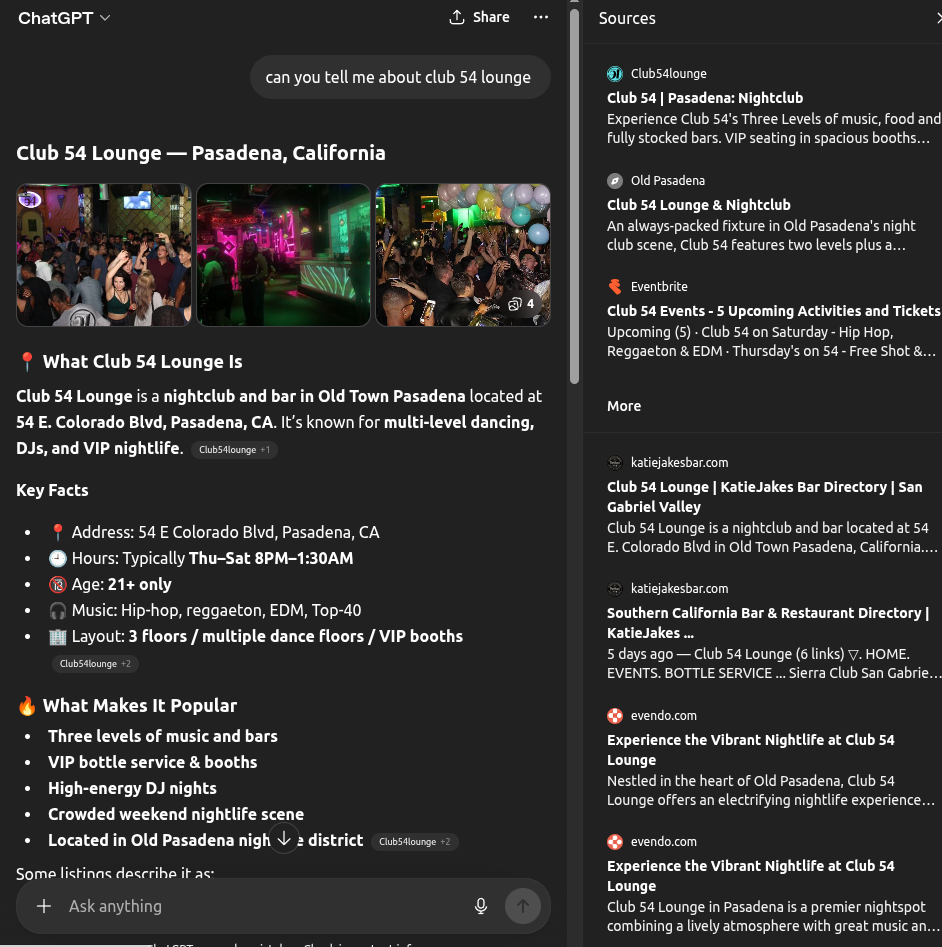
Cited in ChatGPT — Competitor's Query — Category Source
Finding 03
Category Source — Competitor Query — ChatGPT
2 mo.
Local bar. WikiVoyage territory.

A local bar built with graph architecture appeared in Google AI summaries alongside WikiVoyage. Zero ad spend. Zero link building. The structure made it happen inside two months of launch.

46,600
Pages indexed. Under 60 days.

46,600 pages indexed by Google in under two months from a standing start. Declared relationships and full provenance — crawlers follow the edges at a speed that defies conventional expectation.

Source.
Someone asked about a competitor. We appeared.

A user queried ChatGPT about a completely different bar. A graph-structured directory surfaced as a cited source. The graph made it the most authoritative structured source for that category. That is what being the substrate means.

Every business in every category is competing for one answer at a time. The graph architecture doesn't compete for answers. It becomes the substrate from which all answers in a category are generated — permanently, repeatedly, compounding. The difference between a result and a source is structure.

Start Here

Start the
conversation.

Tell us about your domain, your industry, and your current situation. We give you an honest read on where you stand and what the architecture would do for your specific position in the graph.

  • Response within one business day with a direct assessment
  • Initial schema score and gap analysis at no cost
  • White-labeled delivery available for agency partnerships
  • Before and after documentation — measurable, presentable
  • Entity profile minted in the registry at every engagement tier
  • We tell you directly if this is the right fit — or if it isn't

We respond within 1 business day. Your information is never shared or sold.

GraphSignal is a commercial service of the Global Data Registry  —  open provenance infrastructure for the machine-readable web.
View the Registry →